Tech & Building
I Sold My Adobe Shares. Now I'm Building My Own Lightroom.
In June, I bought Adobe shares. The stock had taken quite a beating, and I got in at around $209. I simply thought it had fallen too far. At the end of July, I…
In June, I bought Adobe shares. The stock had taken quite a beating, and I got in at around $209. I simply thought it had fallen too far. At the end of July, I sold the lot at roughly $244. A quick trade, nothing more. I didn't see much long-term upside in Adobe, and I had no interest in staying on as a shareholder.
The funny thing is that a couple of months later, here I am building my own replacement for Adobe Lightroom. That definitely wasn't the plan when I bought those shares.
It started with a much smaller problem.
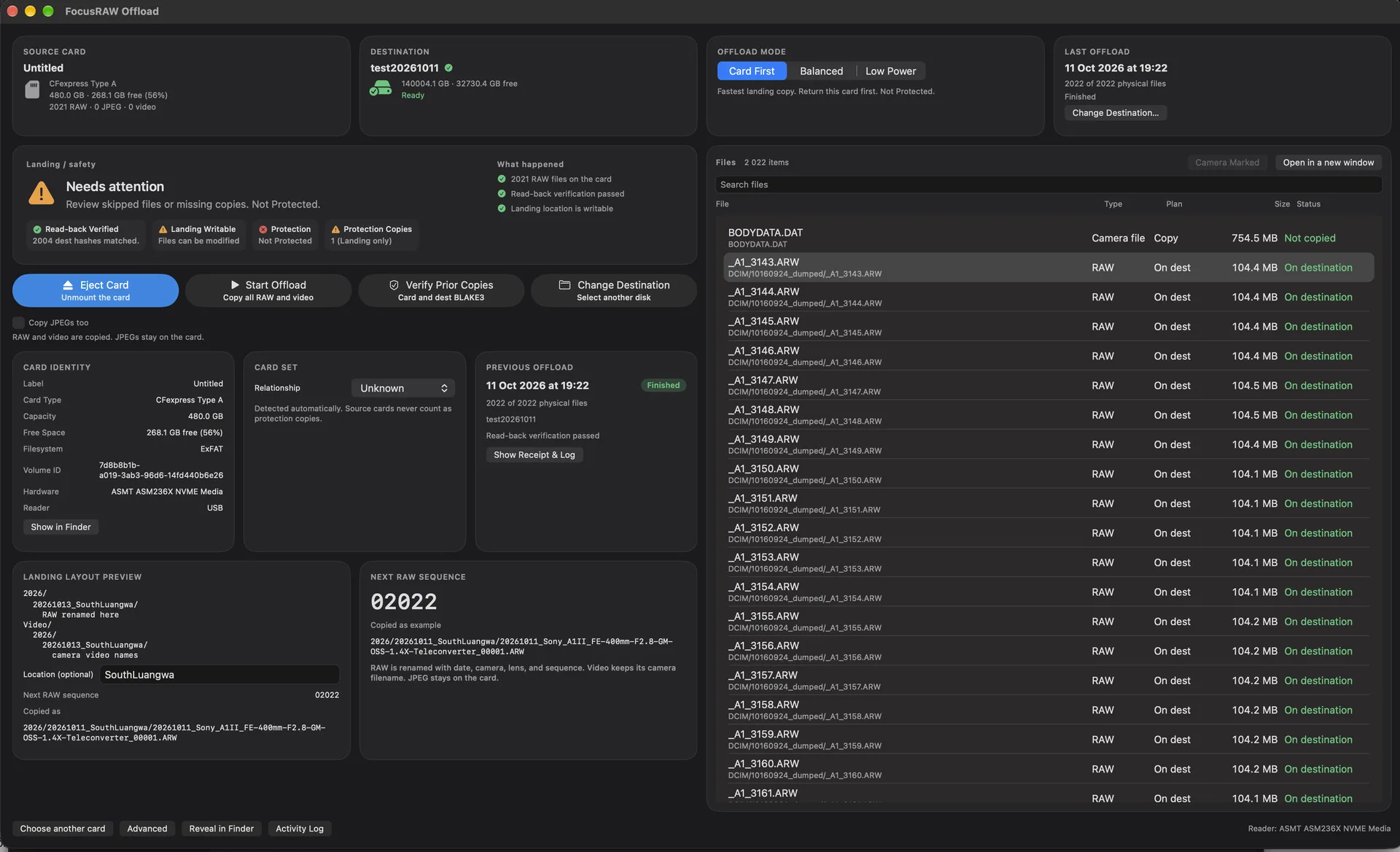
In August, while we were at Zimanga in South Africa, I'd had enough of how I handled memory cards after a day's photography. I wrote about it on the blog at the time. You offload the cards, copy the files, and then find yourself trying to figure out exactly what made it onto the drive and what still exists only on the memory cards. Before formatting anything, you want to be absolutely sure.
Without getting too technical, there's some clever stuff happening behind the scenes. Every file gets a digital fingerprint, called a hash, calculated from the actual data inside the file rather than its filename. We store that fingerprint in a database, and whenever I insert a memory card, Offload checks the files against everything I've previously imported. If the fingerprint matches, we know we've seen that exact file before, even if it has a completely different filename or is sitting in another folder. It's a simple idea, but it solves a problem that has annoyed me for years.
Then there's Sony's annoying file-numbering limitation. Once the counter reaches 9999, it starts over. On a really good day, I can shoot more photographs than that, and suddenly I have multiple files with exactly the same name, taken on the same day. I've dealt with this by creating extra subfolders inside the date folder, say 2026-10-13/sandisk480gb 2026-10-13/lexar960gb, but it's a pretty poor workaround. When I search for a filename later, I can get multiple results with the same date, and I can't immediately tell whether I'm looking at the same photograph or two completely different ones. Not the end of the world, but when you're dealing with thousands of RAW files from a trip, it becomes unnecessarily messy.
So I started building FocusRAW Offload, my own application that would not only copy and verify the files but also automatically rename them using information from the image metadata and its own numbering system. A filename might look something like this:
20261011_ILCE-7RM5_FE-70-200mm-F2.8-GM-OSS-II_01956.arw
Date, camera model, lens and image number. Much more useful information than Sony's standard filenames, and more importantly, I no longer have to keep track of extra subfolders just because the camera's counter has started over.
The project then grew to include backup as well. I wanted something that suited my workflow better than, for example, Jottacloud's 100 TB plan, which gets rather expensive when you actually start filling it with large amounts of RAW files.
It worked, and I kept building other small tools around my photography workflow.
Somewhere along the way, a thought occurred to me. Just how unreasonable would it be to build my own Lightroom replacement?
I discussed it with my AI agent. We went through what would be required and came to pretty much the same conclusion: it was an unreasonable amount of work. Lightroom has been developed for nearly twenty years and contains an enormous amount of functionality, much of it quite complicated beneath the surface.
So I dropped the idea.
A few weeks later, when I got home from South Luangwa in Zambia, I had some AI tokens left over and figured I might as well try a proof of concept. Just to see how far I could get. I enjoy pushing the limits and finding out what's possible. With all my AI agents, 2026 has felt a bit like being Bradley Cooper's character in Limitless. Nothing seems impossible anymore. The only real limitation is the number of hours in a day.
And now I have a project that I'm working on pretty much around the clock, and it's actually starting to become genuinely useful. It's a little difficult to comprehend how quickly things have moved.
And Suddenly Everyone Is Building Adobe Replacements
When you're deeply involved in something, X has a habit of showing you more and more of exactly what you're working on. My feed quickly filled up with people trying to build alternatives to Lightroom and Photoshop.
Then the ArtCraft project appeared, with LightCraft. According to the story, its developer had used Claude to recreate large parts of Adobe's software suite in about a week. PhotoCraft, LightCraft and a whole collection of other applications. All open source.
The GitHub stars started pouring in (the developer equivalent of likes), photography and tech media picked up the story, and before long the same developer was announcing plans to release similar clones of Microsoft's Office applications.
I downloaded LightCraft and gave it a try, mostly out of curiosity since I was building my own Lightroom replacement at the time.
And sure, it looks impressive at first glance. You immediately recognize Lightroom. But after spending about five to ten minutes with it, I was considerably less impressed.
Of course, getting that much software together in such a short time is impressive in itself. But when the next batch of applications is being announced before the first ones are anywhere near finished, I get the feeling that attention and momentum are a bigger part of the project than actually building really good software.
Will they still be developing these applications in three to six months, once the hype has died down? I'm doubtful.
I could be wrong, but that was my impression after trying it.
Then ImageFlow appeared in my X feed. A Photoshop-like editor running entirely in the browser, with layers, masks, adjustments and PSD support.
That impressed me a lot more. I would have been impressed if it were a desktop application, but the fact that it runs in a web browser makes it even more impressive. And it works really well. I haven't put it through any serious testing, but during the five or ten minutes I spent with it, everything I tried worked without a problem. Fast, responsive and no noticeable lag.
Personally, I would never want to edit my wildlife photographs in a web browser. I want a proper application on my Mac, full control over my files, and a workflow that works even when I'm sitting somewhere in Africa with terrible internet. But for someone who needs to open an image, make a few adjustments, work with some layers or put together something for a website? Something like this is perfect.
And I think we're going to see a lot more projects like it.
What's interesting is that many of them won't even need to be built with the intention of making money. I recognize the motivation in myself. You get an idea, start building because it's fun, and suddenly you have something that actually works. Why not release it for free and see if someone else finds it useful?
For a lot of people, the reward will simply be seeing someone actually use something they've built.
That's very different from starting a software company, hiring developers, building an organization and trying to recover the development costs over the next five years.
Five Creative Cloud Subscriptions. Do We Really Need All of Them?
I don't believe for a second that we're about to see a mass exodus from Adobe. Quite the opposite. I think the change will be fairly slow. People have been using Photoshop for ten, fifteen or twenty years. They know the software, they have their files and established workflows, and they have little reason to switch just because something new appears.
But I can use our own e-commerce companies as an example.
We have five Creative Cloud subscriptions. When I look at what they're actually being used for, it's pretty obvious that we don't really need five.
Three people use the applications occasionally for relatively simple tasks. We could build a small in-house app for those exact tasks, tailored to our product photography, banners and other material we produce. I'm fairly confident we could put together something genuinely useful in a week or two.
We would keep the other two subscriptions. Mine, and the one used by the woman who handles our content. She produces newsletters, social media content and pretty much all the graphic material for the company. She genuinely uses Adobe and needs its features. The same goes for me, although if I'm being honest, I could probably replace what I use it for too. That's mainly Lightroom, Photoshop and InDesign for our quarterly financial reports.
So we'd still be Adobe customers. Just with two licenses instead of five.
That's roughly how I think things will develop at many companies. Not that everyone wakes up one morning and decides to abandon Adobe completely, but that businesses gradually realize they don't need as many licenses as they used to.
Nothing particularly dramatic from one day to the next. But if enough companies do this over a long enough period, it will obviously start to hurt.
Then there are the more technically inclined users. People who don't necessarily know how to build software themselves, or have any desire to, but who are perfectly comfortable trying alternatives. They'll discover tools like ImageFlow, give them a go, learn a new interface and perhaps realize they don't actually need Photoshop for what they're doing.
And then there's the last group. People like me, who start building things themselves.
That group is probably a lot smaller than many AI enthusiasts would like to believe.
Why Pay for an App When You Can Build Exactly What You Want?
I think hyper-personalized software is going to become a very big thing, both for businesses and individuals.
I've already started building more and more of our internal systems myself. Purchasing, warehouse operations, various tools for our e-commerce business. Software that does exactly what we need and that we can change whenever our needs change. We don't have to adapt our business to someone else's idea of how a particular application should work.
And now I'm doing the same with Lightroom, only for my personal use.
That's obviously a fairly advanced example. I certainly wouldn't recommend that someone who just wants to edit their holiday photographs should start developing their own photo editor. But think about all the little apps we use.
A notes app. A fitness app. A to-do list. Something to keep track of trips, equipment, projects or whatever else you're interested in.
There are hundreds of apps for almost every imaginable need, and every one of them has its own idea of how you're supposed to work. Often they cost a few euros a month. Five euros here, five euros there, and suddenly you're paying for a whole collection of apps that almost, but not quite, do what you want.
Why not build your own?
For around €20 a month, you can get a Lovable subscription and build several small web applications tailored to your own needs.
I can easily imagine someone building their own notes app, workout log and to-do list, making them work exactly the way they want, and then simply using them. No need to convince a developer to add a particular feature, wait for the next release or spend hours trying to find the right app among fifty alternatives in the App Store.
Personally, I tend to get caught up in the details. How a folder structure should be displayed, where a button should sit, which settings should be available and which ones absolutely shouldn't be there. Spending hours on that sort of thing might not be particularly rational, but it's my software. I want it my way.
I think more people are going to discover that they can actually have that.
But of course, the majority won't start building their own apps. They just want something that works. And that's where I think all these thousands of little projects people build for fun will find their place. Someone else has already built something that's good enough, perhaps even better for that specific purpose than the big commercial alternative.
I suspect we'll end up with a "vibe coder" in every group of friends. The person who builds apps for everyone else in the group.
Sometimes all it takes is someone who thought it would be fun to build something.
I know how easy it is to end up there.
And What About Adobe?
I still don't think Adobe is going to lose a huge share of its customers anytime soon. They have fantastic products, an enormous installed user base and plenty of professional users who depend heavily on their software.
I think it's more likely to be a gradual shift, with some customers leaving, others reducing the number of licenses they pay for, and some simply deciding to stop paying for features they rarely use.
Adobe will undoubtedly adapt as well. My guess is that the traditional applications will eventually get a different pricing structure, while more of the revenue comes from AI features, generation and automation. At least that's one direction I can see them taking.
We've already seen a shift from generative AI being included to subscriptions that come with a fixed monthly allowance of generative credits. My guess is those allowances will shrink further, pushing users towards paying for additional credits.
It'll be interesting to see what the new leadership does.
But I have no particular desire to own Adobe shares over the long term right now. I didn't back in the summer either, even though I thought the stock had become too cheap in the short term.
What I have gained, however, is a completely different appreciation for how much work has gone into Lightroom. You discover that pretty quickly when you start trying to build something similar yourself.
My own application, FocusRAW Pro, has already come much further than I thought possible in such a short time. Just a week ago, I couldn't imagine seriously replacing Lightroom with it. Now I'm starting to consider it.
There are still some important things left to tackle. I haven't really dug into noise reduction yet, and I'm still not entirely happy with the color profiles. For the kind of photography I do, those are not minor details.
But I'm now developing my own photographs in a RAW editor that I'm building myself.