Tech & Building
No more waiting for the reset
The last two posts were about the machine and about why the spend only looks crazy from the outside. This one is about the constraint I am done living with.
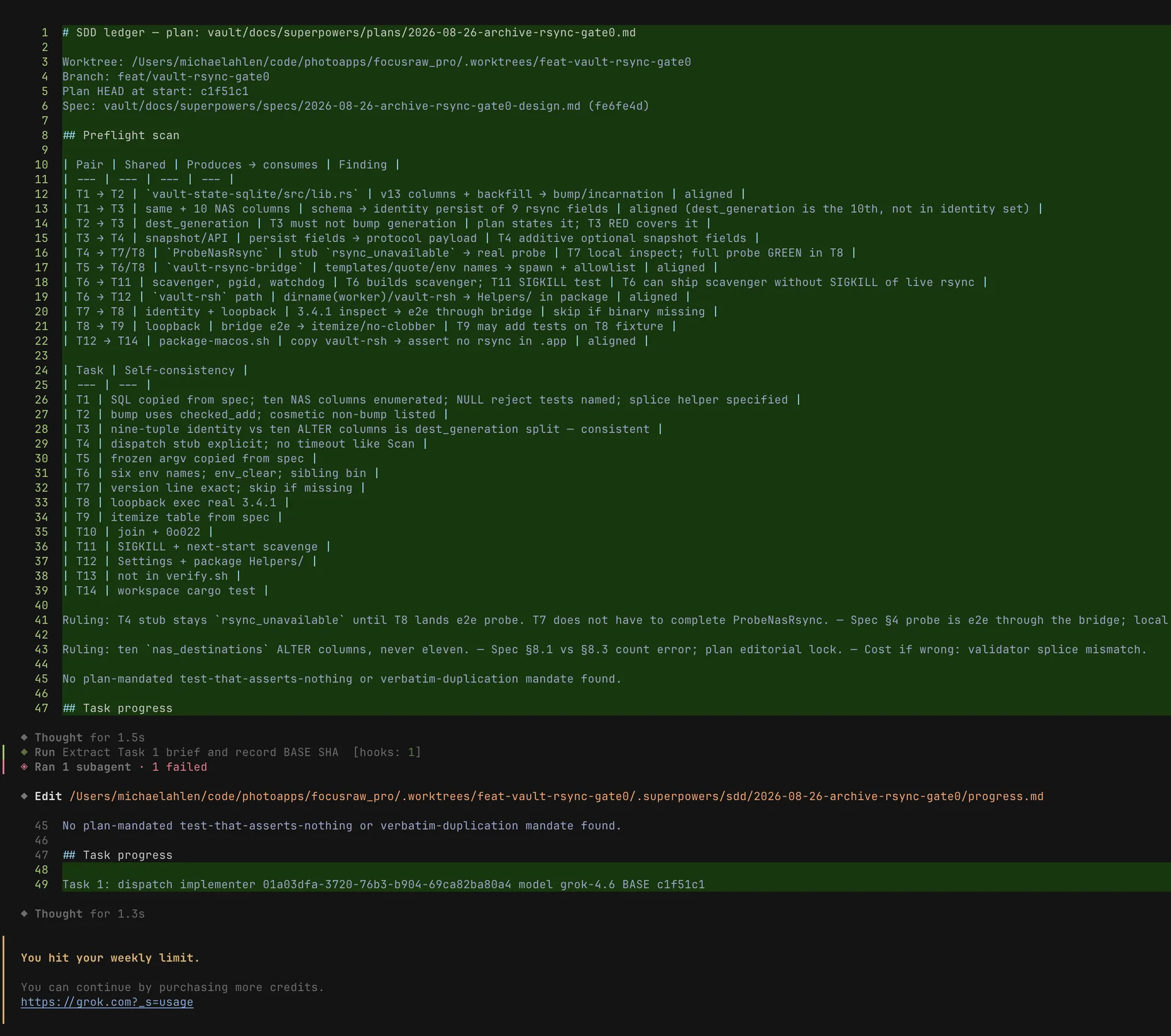
Even when I hold back, I am already working across eight or ten repos at the same time. That is the restrained version. Different companies, different systems, different agents, all open and all moving. The problem is not that I have too much going on. The problem is that the ceiling still shows up in the middle of a good day and starts deciding what gets to continue. No more, Honey! I can't watch a movie with you tonight, I have a few tokens left and there is a reset in 2hours I need to max them out before the reset...
I hate that.
Not the hardware invoices. Not the noise from the outside about how much all of this costs. I hate the moment when the work is flowing and I still have to start killing agent coding work. This repo can wait. That agent can sit idle until next week. These three jobs should have been running overnight, but the tokens meter is already getting thin. Suddenly I am allocating tokens instead of allocating ideas.
That is a stupid constraint.
I do not want eight repos with the handbrake on. I want the ceiling gone. If the day needs twenty repos, twenty repos. If it needs ten repos with thirty agents working in parallel, then thirty agents. Same hour. Same desk. No queue. No deciding which project deserves oxygen because Thursday happens to be closer to the reset than Monday.
So I am buying more max plans on my wife's account. Another ChatGPT Pro because Sol 5.6 is just that good right now. Another Grok Super Heavy. They will run on a second computer so the work can stay parallel instead of everything fighting over one seat. At the volume I want to run, API credits become crazy expensive compared with the flat max plans. I would rather pay for another subscription and keep moving than spend part of the day thinking about the tokens meter.
There is a slightly funny detail here. In the last post I wrote that I was buying more local compute partly to reduce the need for more cloud subscriptions.
That was half a day ago.
Today I hit the wall on several subscriptions again.
So yes, I have already changed my mind.
The local compute is still absolutely worth it. I want more of it, not less. But I no longer think the answer is local instead of cloud. The answer is both. Enough local compute to run the heavy work continuously, and enough cloud capacity that the best models are there whenever I need them.
That probably sounds inconsistent if you read the posts back to back. It is. But that is also what this moment feels like. Things are moving so fast that I can write down a conclusion on Monday morning and find out by Monday evening that I was thinking too small.
When the M5 Ultra shows up, the M3 Ultra does not leave the desk. It gets a new job as a dedicated local coding machine. The M5 Ultra becomes the main workstation. The two Sparks keep running whatever local models are strongest that week. Cloud models sit on top for planning, architecture and the hard problems, and coding as much as the tokens will do.
Main machine. Dedicated local coder and running all my CLIs. Dual Sparks. Cloud. All of it running at once.
And then Apple announced the 512GB M5 Ultra. My first thought was obvious as i wrote in the blog post. I should buy one. Just now about 10 hours later I was already thinking, should I buy two? Maybe three?
That sounds ridiculous when you describe them as computers. It sounds less ridiculous when you start thinking about them as capacity.
When I was a teenager, an older and much more experienced entrepreneur told me something that stayed with me. I do not remember the exact words anymore, but the idea was that the wealth you could build was in some way proportional to the number of people you employed, or perhaps more accurately, the number of people you could serve through the organisation you built. At that time I was fully happy being self employed doing alright, his perspective changed my mind-set and I started to employe people, and we grew and my wealth grew with it, just as he had implied.
If you wanted to build something big, you built a company. If you wanted the company to become bigger, you hired more people. More developers, more salespeople, more finance people, more designers, more managers. Human capability was the scarce resource, so scaling meant assembling more of it.
That was the world I grew up in. I think AI is starting to break that relationship.
For the first time in my life, scaling an idea does not automatically mean scaling the number of people around it. It can mean scaling intelligence and compute. Another model. Another agent. Another machine. Another twenty or thirty processes working while I sleep.
For most of my career, if I wanted ten things built at the same time, I needed ten people somewhere in the organisation capable of building them. Now I can put another machine under the desk, give it models, agents and work, and increase how much one person can have moving at the same time.
That is a profound change.
I keep thinking about Sam Altman talking about the first one-person billion-dollar company. A company that would have sounded almost impossible before AI.
A few years ago I would probably have dismissed that as Silicon Valley exaggeration. Today I can actually see the path.
I am obviously not a kid building the next billion-dollar company in his mother's basement. I am an old guy sitting in my home office. But I understand the idea now in a way I did not even a year ago.
The entrepreneur I met as a teenager was completely right for the world he was operating in. Wealth was closely tied to the organisation you could build because people were the unit of productive capacity.
I am starting to wonder if the new version is something else. What you can build may increasingly be proportional to how much intelligence you can orchestrate.
That is why this feels a little like 1999 to me. Not because I think everything involving AI is going to make money. Most of it probably will not. It feels like 1999 because the economics of what one person can attempt have changed faster than most people have adjusted their thinking.
The internet dramatically reduced the cost of distribution. AI is reducing the cost of capability.
Software development, research, design, analysis, testing, operations. Things that historically translated almost directly into headcount can increasingly be turned into compute. Not completely, and not perfectly, but enough that the economics are already different.
That is the Klondike part.
Not that everyone digging will find gold. Most probably will not. But suddenly there is gold in the river, and for a while the people who understand what just changed have an advantage over the people who are still debating whether the river looks different.
That is the part I find difficult to ignore.
It is also why spending this much on hardware no longer feels particularly strange to me. I am not buying a computer because I want a faster computer. I am not buying another AI subscription because I want another chatbot. I am buying parallelism. I am buying capacity. I am buying the ability to wake up, point twenty agents at twenty useful things and let them work while I move between them.
The coding work. The investment system. The company tools. The FocusRAW apps. The weird side projects that suddenly turn into real products. I want all of them moving at the same time instead of maintaining a mental queue of things I am perfectly capable of doing but cannot run because I have hit another artificial ceiling.
I keep thinking about Limitless. Not the pills. The feeling. Foot on the floor. Brain running faster than the world around you. No choosing which fire gets oxygen. No deciding which idea gets pushed to next week because the meter happens to be low.
That is what I want from this setup.
And the interesting thing is that we are finally close. Local models are good enough to do a huge amount of the heavy lifting. Cloud models are still the sharp edge when the problem gets difficult. The hardware is either already on the desk or weeks away. Agentic coding has gone from an interesting experiment to the way I actually work.
Six months ago I was thinking about which model was best.
Now I am thinking about how much intelligence I can keep running in parallel before I become the bottleneck myself.
That is a very different problem.
For most of my career, scaling an idea meant hiring people.
For the first time, scaling an idea can mean adding compute.
Maybe in a few years everyone works this way and none of this feels unusual anymore. Maybe the advantage disappears completely. But it does not feel normal yet. We are in that strange window where one person with the right tools can suddenly attempt things that would have required an entire team, real capital and a completely different organisation not very long ago.
I have no idea how long that window stays open.
But I know one thing.
Now is not the time to take the foot off the gas.
I do not want to ration.
I want to run.
Today. Not tomorrow. Not after the reset.