Craft
When the Sensor Doesn’t See It: Autofocus Limits in Extreme Wildlife Conditions
There’s a quiet truth most wildlife photographers avoid admitting: even the best autofocus systems fail. Not in specs. Not in marketing demos. In the field, where heat, dust, weather, distance, and animal behaviour all collide, you eventually hit a point where the camera simply doesn’t understand what it’s seeing.
That moment is where frustation or craft begins.
The Comfort of Believing AF Can Solve Everything
Modern bodies like the Sony A1 II and Canon R1 have conditioned photographers to expect near-perfect recognition. And in clean conditions, they deliver exactly that. A single subject, predictable movement, balanced contrast, no challenge at all.
The problem is assuming that performance holds everywhere.
The real world introduces variables that break the algorithm. This isn’t a weakness of the camera. It’s just physics, behaviour, and atmosphere behaving in a way machine vision doesn’t fully grasp yet.
The photographers who prepare for these moments consistently land the frames others miss.
Heat Haze: The AF Killer You Can’t Outrun
Heat shimmer is one of the conditions where autofocus fails in a visibly obvious way. At long focal lengths, the air becomes the dominant optical surface. Edges wobble. Micro-contrast collapses. Subjects bend and distort.
An example: Mana Pools, late afternoon. A pride of lions feeding on a zebra roughly 70–90 meters away. I was on the GFX100 with the GF500. They weren’t running or fighting, just slow walks between feeding. But even in this calm situation, the atmosphere was so unstable that the AF had nothing solid to interpret. Heads, faces, ears: they all shifted as if floating under water.
Because the behaviour was slow and predictable, the solution was simple:
Field solution:
– Use single-point AF and place it directly on the head. Give the system one clear instruction.
– If haze is too strong, switch to manual focus. No pressure, no rush, just subtle corrections as the air moves.
– Avoid tracking modes; stability matters more than speed.
Heat haze will always beat AF. But when the subject isn’t moving fast, the workaround is fully under your control. And it’s worth noting: very rarely will a frame shot through heavy shimmer turn into a great image anyway; the atmosphere usually destroys fine detail long before autofocus does. But those rare moments do happen, and when they do, you still need the skill to handle heat haze properly. That’s the difference between coming home empty-handed and at least having a usable frame from a difficult scene.
Low-Contrast Snow and Ice: When Weather Removes Every Anchor
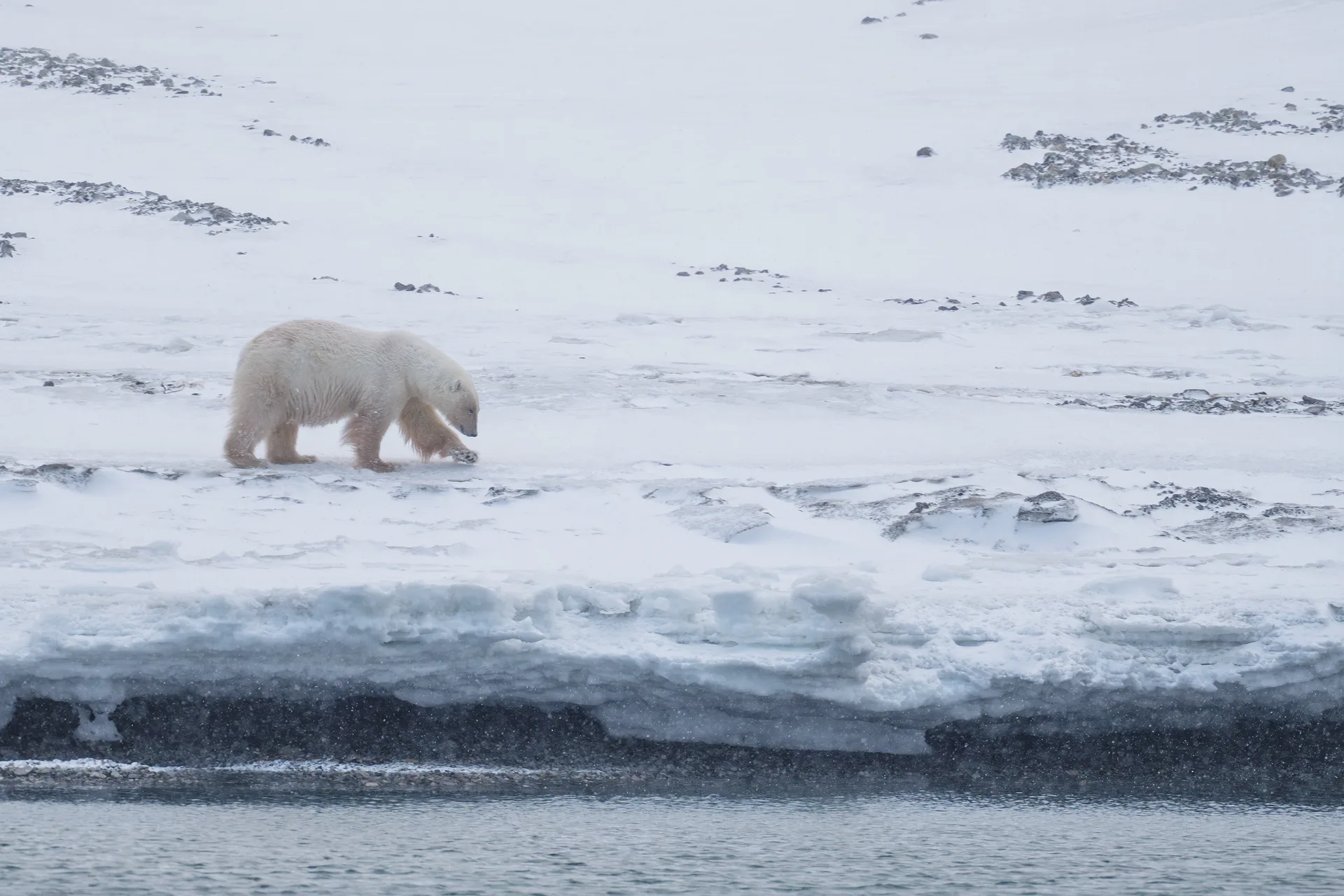
Arctic failures come from the opposite direction, too clean, too white, too flat. Add weather to that (light snow, wind, drifting frost) and a polar bear becomes a low-contrast shape moving through a scene with no edges for the AF to lock onto.
To the camera, a bear in these conditions is a low-contrast shape moving through an all-white scene, with weather adding random micro-movement the algorithm can’t reliably interpret. Combine that with the platform motion (even subtle shifts from the ship at long focal lengths) and the camera can easily lose the subject, hunt, or re-acquire the wrong area. This is one of those scenarios where full manual focus often delivers more stability than any tracking mode.
When this happens, trusting the AF becomes a liability.
Field solution:
– Switch to small single-point AF if the conditions are manageable.
– If the platform motion is too strong, go full manual focus: take control and stabilize the plane yourself.
– Use the bear’s gait and direction to anticipate micro-pauses.
– Time your shot during those brief stability windows instead of trying to shoot through constant movement.
In these situations, full time manual focus paired with behavioural timing is often more reliable than asking the camera to focus on a subject it barely sees.
Dense Vegetation: The Sensor’s Constant Temptation
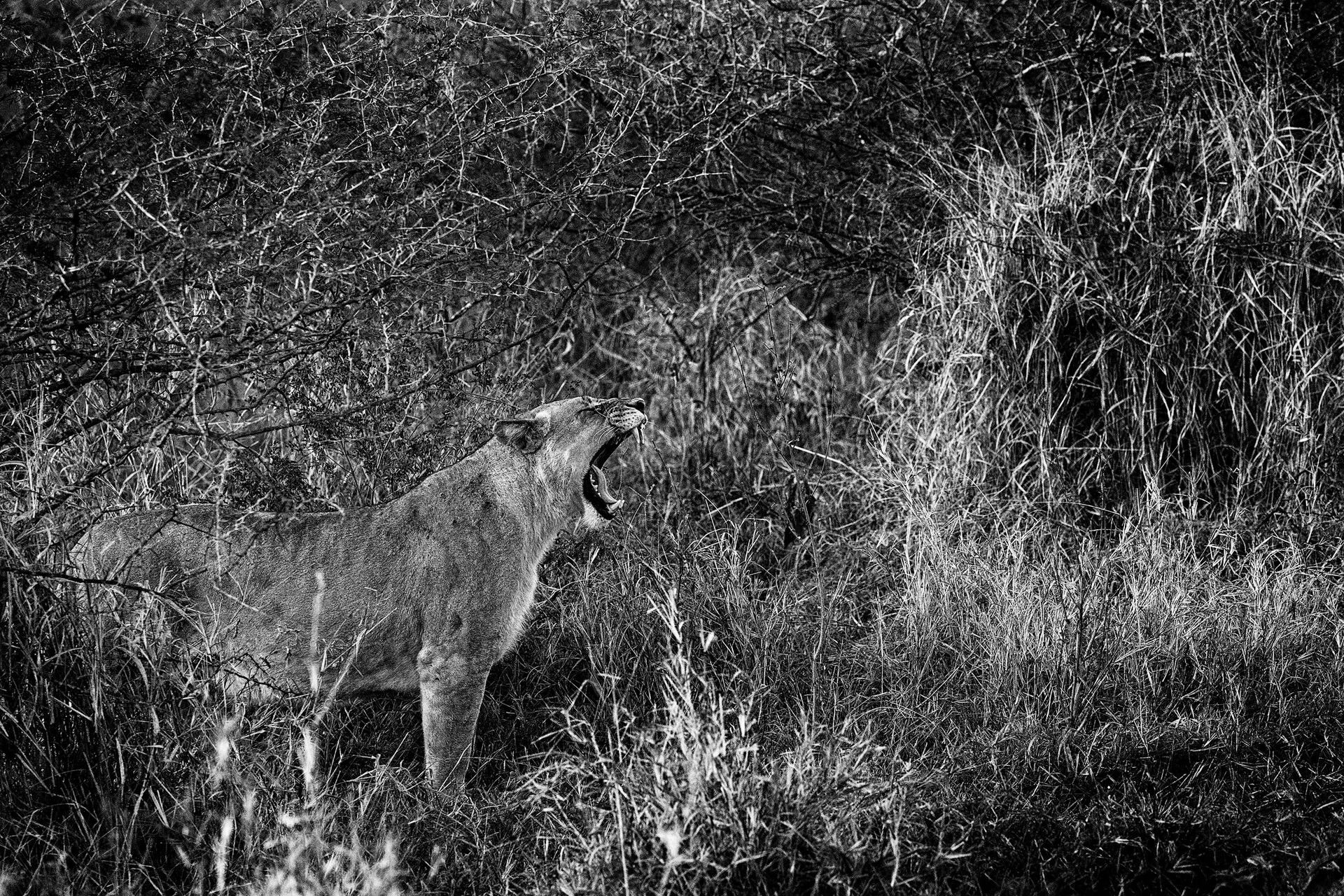
Grass and branches often have stronger contrast edges than the actual animal. Autofocus sees contrast, not intention. A predator moving through vegetation is one of the worst-case scenarios: the subject hides inside chaotic detail while the camera grabs the sharpest foreground line.
Field solution:
– Use manual override as the animal approaches.
– Track movement rhythm instead of visual clarity.
– Predict the moment it will clear the vegetation.
– Pre-focus where that opportunity will happen.
This is where behavioural reading beats every form of automation.
When Two Elite AF Systems Behave Differently
The Sony A1 II autofocus is exceptional.
In clean, simple scenarios, like a golden eagle dropping into a fish strike with no distractions, it’s arguably the best tracking system available today. The camera locks, interprets intent, and follows flawlessly. The R1 isn’t far behind, but the A1 II retains a slight edge in these ideal conditions.
But these “perfect” scenes are the easy ones.
When things turn messy, complex layers, overlapping subjects, low contrast, unpredictable behaviour, the camera with the technically superior AF isn’t always the best tool. And this is where the Canon R1 becomes my primary choice, even at half the resolution.
It has nothing to do with megapixels; it’s about control.
Canon gave the R1 something Sony still lacks: extreme, deep customization that strengthens decision-making in chaotic moments. And the R1’s standout feature is the touch focus button.
Dual-stage. Half-press. Full-press.
In a fraction of a second, I can move a single-point AF box to exactly where it needs to be, without changing grip, without breaking viewfinder contact, without hesitation.
In vulture gatherings, for example, the camera has no clue which bird you want. Not yet, at least. Maybe in a few years systems will understand composition and predict photographer intention. Until then, the R1 lets you declare intent instantly.
Same in low-contrast scenes.
Slide the finger, place the point, lock, and let AF take over.
This precision is why the R1 outperforms the A1 II in the most complex environments, even though the Sony is slightly better in clean scenarios where you can be lazy and just track the whole frame.
Building a Backup System for When AF Breaks
The best wildlife photographers run a second operating mode the moment AF begins to fail:
– Pre-focus by distance rather than sight (too many don't use this function on superteles)
– Read behaviour as the primary cue
– Use cadence (gait, wing rhythm) to anticipate alignment
– Shoot fewer frames but with higher intention
The point is not rejecting autofocus but knowing when to stop trusting it.
The Real Lesson
Autofocus is a tool, not a guarantee.
Understanding where and why it breaks gives you an advantage. When the sensor stops interpreting the world correctly, you rely on your own awareness. That transition, from machine vision to human decision, is where real wildlife craft lives. I'm lucky I started my photography career back in the days where auto focus wasn't at todays fantastic levels.